

You walk into a pharmacy and see shelves packed with bottles. The labels promise “immunity,” “energy,” “detox,” “heart health.” And the urge is understandable: build a “health stack,” take it every day, and feel like you’ve handled the topic.
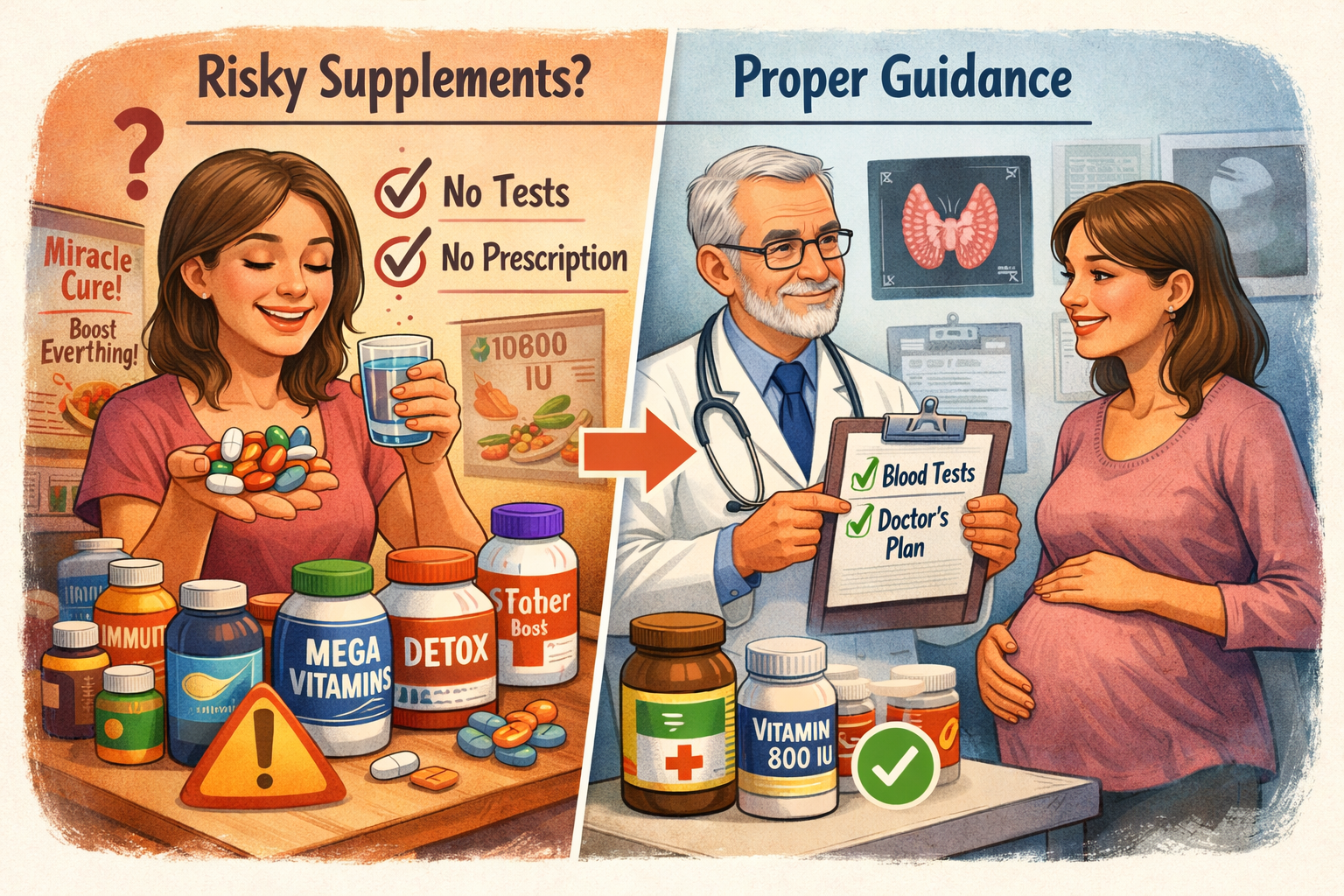
This article is specifically about the most common real-life scenario: taking vitamins and supplements without lab tests, without a diagnosis, and without a clinician prescribing them—just “for general health.” In other words, it’s what you can reasonably do (and what you should avoid) when your plan is simply: “I’ll just take something.”
US and European clinical guidelines read this landscape differently. They don’t start with “what’s good for everyone.” They start with a tougher question: in which situations does a supplement reliably prevent deficiency or meaningfully affect health outcomes. Those situations exist—but there are far fewer of them than the product lineup suggests.
The boundary of this guide: if you do have lab results, a confirmed deficiency, a diagnosis, pregnancy complications, or a clinician’s plan, that’s a different mode. In those cases, the right dose, form, and duration may be very different (sometimes higher and more specific) than what makes sense without testing.
Disclaimer: this is general educational information and not medical advice or a personal prescription. If you are pregnant, have chronic conditions, take medications, or have symptoms you’re concerned about, talk to a qualified clinician.
Folic acid (B9): a rare “almost everyone” supplement—within one specific group
If you only read one section and want one practical recommendation, make it this one. Neural tube defects develop very early in pregnancy, often before someone knows they’re pregnant. That timing is why guidelines don’t rely on “let’s test first.” They treat prevention as the safest default.
Do
- If you’re planning pregnancy or you could become pregnant, take folic acid 400–800 mcg daily.
- Start before conception and continue at least through the end of the first trimester (often phrased as “until 12 weeks”).
Don’t
- Don’t replace folic acid with “I’ll just eat well.” Nutrition matters, but it doesn’t solve the timing problem.
- Don’t jump to high doses “just in case.” Higher-dose protocols are for specific high-risk situations and belong in clinician-guided care.
Iodine: not a “thyroid booster,” but a pregnancy and breastfeeding essential
A common mistake is to see “thyroid” and start taking iodine whenever you feel tired, cold, or your “metabolism is slow.” Guidelines put the spotlight elsewhere: iodine becomes critical during pregnancy and breastfeeding, because needs rise and deficiency can affect a child’s development.
Do
- During preconception, pregnancy, and breastfeeding, ensure ~150 mcg/day of iodine, usually via a prenatal.
- Prefer standardized forms such as potassium iodide, where the dose is predictable.
Don’t
- Don’t use seaweed/kelp capsules “by feel.” Doses can be highly inconsistent.
- Don’t take iodine long-term simply because it’s “good for the thyroid.” In several thyroid disorders, excess iodine can worsen the situation and dosing should be individualized.
Vitamin D: yes—but no megadoses and no fantasies about “preventing everything”
Vitamin D got pulled into marketing gravity. Over time it became linked to nearly everything. Guidelines bring it back to basics: vitamin D is useful for deficiency prevention in risk groups, while “everyone, for everything” is not supported.
Children
Guidance for infants and toddlers is typically direct: the goal is clear—prevent deficiency and rickets.
Do
- Follow age-based prevention guidance (often stated as):
- 0–12 months: 400 IU/day
- 12–24 months: 600 IU/day
Don’t
- Don’t wait “until we do labs.” In infancy, prevention is the point.
Pregnancy and breastfeeding
European guidance often ties advice to low-sun seasons; US endocrine guidance generally allows empirical supplementation in risk groups and discourages routine testing without indications.
Do
- Consider 400 IU/day (10 mcg/day) during pregnancy and breastfeeding, especially in low-sun months and if sun exposure is limited.
Don’t
- Don’t treat vitamin D as a universal “immune pill.” Without testing, the most defensible use is still deficiency prevention.
Older adults: how much vitamin D without testing?
Recommendations vary, but they fall into a clear corridor. In the UK, the population reference is often 400 IU/day (10 mcg/day) year-round, while US dietary reference intakes commonly use 800 IU/day (20 mcg/day) for adults 71+. Bone-health organizations sometimes cite 800–1000 IU/day (20–25 mcg/day). For a conservative “no tests” guide, a practical baseline for older adults is usually 400–800 IU/day, with people who get very little sun or are mostly homebound leaning toward the upper end. Avoid drifting into megadoses by default: the UK NHS notes an adult upper daily limit of 100 mcg/day (4000 IU/day).
Important “don’ts” for everyone
- Don’t use bolus regimens like “50,000 IU once a month” as an automatic prevention plan.
- Don’t chase a “very high” 25(OH)D level as a goal—especially if you aren’t testing and aren’t treating a diagnosed deficiency.
Iron: often yes in pregnancy; outside pregnancy, confirm deficiency and use a course
Iron is the supplement people self-prescribe based on symptoms—fatigue, dizziness, hair shedding. The problem is that these symptoms are non-specific. Iron also has a cost: GI side effects are common, and it’s easy to take iron when deficiency isn’t actually the issue.
Do
- In pregnancy, daily needs are often around ~27 mg/day (commonly covered by prenatal vitamins).
- Outside pregnancy: confirm deficiency first (hemoglobin, ferritin, sometimes CRP), then treat with a time-limited course.
Don’t
- Don’t take iron continuously “because you’re a woman of reproductive age.” Guidelines don’t frame it that way without evidence of deficiency.
- Don’t take iron randomly with coffee/tea or alongside calcium if you’re correcting deficiency—absorption is sensitive to timing.
Vitamin B12: if you’re vegan, this isn’t optional—it’s basic insurance
B12 isn’t dramatic, it’s structural. Reliable dietary sources are mostly animal-based. If you strictly avoid animal foods, deficiency risk rises.
Do
- If you’re vegan (or close to it), use fortified foods and/or a B12 supplement regularly, long-term.
Don’t
- Don’t rely on spirulina/chlorella as your B12 plan. If you’re wrong, you’ll find out late.
Vitamin A (retinol): the key point is pregnancy safety
Vitamin A often sneaks in via cod liver oil, “skin & hair” formulas, or “immunity blends,” and then someone discovers they’re pregnant. In a “no tests, no prescription” scenario, the safe approach is simple: avoid retinol supplements in pregnancy.
Do
- If you’re pregnant (or might be), read labels carefully. Use prenatal-designed products.
Don’t
- Don’t take cod liver oil or retinol supplements during pregnancy unless a clinician specifically advises it.
Multivitamins: often a psychological safety net, weak evidence for major prevention
For many healthy people, multivitamins are bought less as treatment and more as anxiety relief. Guidelines tend to be politely skeptical: strong evidence that multivitamins prevent major outcomes in broadly healthy populations is limited.
Do
- If your diet is genuinely constrained (medical diets, low intake, major exclusions), a multivitamin can be a temporary bridge while you fix the baseline.
Don’t
- Don’t treat multivitamins as a strategy to prevent “heart disease and cancer.” That’s not where guidelines see convincing benefits.
Vitamin E and beta-carotene: two antioxidant cautionary tales
These were marketed for decades as “cell protection.” Large trials and guideline reviews cooled the hype.
Beta-carotene in smokers
Do
- Get carotenoids from food: vegetables and fruit come with a different dose context and broader benefits.
Don’t
- If you smoke or have a significant smoking history, don’t take beta-carotene as a supplement.
Vitamin E
Do
- Leave vitamin E in the grocery basket: nuts, seeds, and oils.
Don’t
- Don’t take vitamin E “for immunity” or “for heart protection” as a routine preventive habit.
Calcium: food first; pills only when the reason is clear
Calcium is usually best handled through diet. Tablets can be useful in specific contexts, but “everyone should take calcium for bones” is a poor default without evaluating intake and risk.
Do
- Estimate your dietary calcium. If it’s low, try to fix intake through food first.
- If you have osteoporosis or you’re on targeted bone therapy, calcium and vitamin D may be part of a clinician-guided plan.
Don’t
- Don’t take calcium “just in case” as a daily habit without a clear reason.
Omega-3: fish is a solid habit; capsules for everyone are not a guideline-level claim
People often treat “eating fish” and “taking fish oil” as interchangeable. They aren’t.
Do
- If you want heart-friendly action without medication, start with diet: fish intake and overall dietary patterns are more reliable than “default supplements.”
Don’t
- Don’t take omega-3 capsules as a universal “prevent heart attacks” plan.
Where it becomes medical therapy
- Some lipid guidelines recommend prescription EPA (icosapent ethyl) for specific high-risk groups with elevated triglycerides on statins. That is not the same thing as over-the-counter fish oil.
Red yeast rice: a “natural statin” with real statin-like issues
Red yeast rice is marketed as a gentle alternative to statins. In practice, the active component can behave like a statin, while product quality and dosing vary widely.
Do
- If your goal is lower LDL, start with diet and risk assessment. If medication is indicated, discuss evidence-based therapy with a clinician.
Don’t
- Don’t use red yeast rice as a casual “safe natural statin” in a no-tests setup.
Probiotics: not “daily for immunity,” but useful in a short, specific scenario
Probiotics are a good example of “narrow but real.” As a category, they can reduce antibiotic-associated diarrhea risk in adults in meta-analyses, but that’s not a reason to take them indefinitely.
Do
- If you’re starting antibiotics and you’ve had antibiotic-associated diarrhea before, consider a probiotic for the duration of the antibiotic course.
Don’t
- Don’t take probiotics continuously “for the microbiome” without a clear goal.
- If you’re immunocompromised or seriously ill, don’t self-prescribe probiotics—discuss safety first.
Psyllium (soluble fiber): a simple tool for LDL and bowel regularity
This isn’t a vitamin. It’s a functional add-on with a clear mechanism: soluble fiber binds bile acids, can gently lower LDL, and often improves stool regularity.
Do
- If you’re low on fiber or want modest LDL support, psyllium can be used long-term.
- Start small, increase gradually, and drink plenty of water.
Don’t
- Don’t take it dry or “a big spoon at once.” That’s how you get bloating and discomfort.
Creatine: excellent for training—still not a general wellness pill
Creatine is one of the most evidence-supported sports supplements. It helps with high-intensity performance and supports muscle mass in the context of resistance training.
Do
- If you lift or care about performance: 3–5 g/day of creatine monohydrate, consistently.
- Choose plain monohydrate rather than “matrix” blends.
Don’t
- Don’t expect creatine to fix sleep, stress, or diet.
Why “everything else” usually isn’t worth it (without tests)
Most bottles fail at one of three steps:
- They improve a biomarker but not meaningful outcomes.
- They only help in deficiency—and most people aren’t deficient.
- Dose and form matter, and supplements aren’t standardized like medications.
That’s why this guide stays conservative: if you’re not testing and you don’t have a clinician’s plan, your default should be “less, but more targeted.”
One-screen checklist (the “no tests, no prescription” approach)
Do
- Folic acid 400–800 mcg/day if you could become pregnant.
- Iodine ~150 mcg/day in a prenatal during preconception/pregnancy/breastfeeding.
- Vitamin D by age and risk (infants, low-sun season, older adults).
- B12 regularly if you’re vegan.
- Psyllium if you’re low on fiber or want modest LDL support.
- Probiotics during antibiotics if you have AAD/C. difficile risk.
- Creatine 3–5 g/day if you train for strength/performance.
Don’t
- Don’t use vitamin E or beta-carotene as routine “prevention.”
- Don’t take retinol/cod liver oil in pregnancy.
- Don’t take calcium pills “just in case.”
- Don’t use red yeast rice as a casual “natural statin.”
- Don’t treat fish oil capsules as universal heart prevention.
If you do have labs or a doctor’s plan
Treat this article as background reading. Confirmed deficiencies, thyroid/kidney disease, anemia, osteoporosis, lipid disorders, complicated pregnancy, and medication interactions can completely change the right dose, duration, and even the right supplement.
Sources
- USPSTF — Folic Acid Supplementation to Prevent Neural Tube Defects (Grade A): https://www.uspreventiveservicestaskforce.org/uspstf/recommendation/folic-acid-for-the-prevention-of-neural-tube-defects-preventive-medication
- NHS (UK) — Vitamins, supplements and nutrition in pregnancy (folic acid; avoid retinol/cod liver oil):
https://www.nhs.uk/pregnancy/keeping-well/pregnancy-vitamins-and-supplements/ - American Thyroid Association (2017) — Thyroid disease in pregnancy/postpartum (iodine): https://www.e-lactancia.org/media/papers/TiroidesLevotiroxinaLiotironinaBFGuia-Thyr2017.pdf
- European Thyroid Association (2014) — Iodine intake in pregnancy/lactation (guideline): https://pmc.ncbi.nlm.nih.gov/articles/PMC4109520/
- CDC — Vitamin D (infants/young children): https://www.cdc.gov/breastfeeding-special-circumstances/hcp/diet-micronutrients/vitamin-d.html
- UK SACN — Vitamin D and Health report (RNI 10 mcg/400 IU): https://www.gov.uk/government/publications/sacn-vitamin-d-and-health-report
- NHS (UK) — Vitamin D (general advice; upper limit): https://www.nhs.uk/conditions/vitamins-and-minerals/vitamin-d/
- Endocrine Society (2024) — Vitamin D for the Prevention of Disease: https://www.endocrine.org/clinical-practice-guidelines/vitamin-d-for-prevention-of-disease
- IOM/NAM (2011) — Dietary Reference Intakes for Calcium & Vitamin D (RDA 800 IU for 71+): https://pubmed.ncbi.nlm.nih.gov/21118827/
- ACOG (2021) — Anemia in Pregnancy (iron; 27 mg/day): https://journals.lww.com/greenjournal/fulltext/2021/08000/anemia_in_pregnancy__acog_practice_bulletin%2C.34.aspx
- NHS (UK) — The vegan diet (B12 may be needed): https://www.nhs.uk/live-well/eat-well/how-to-eat-a-balanced-diet/the-vegan-diet/
- USPSTF (2022) — Vitamin/mineral supplements to prevent CVD and cancer (against vitamin E & beta-carotene; insufficient evidence for most): https://www.uspreventiveservicestaskforce.org/uspstf/recommendation/vitamin-supplementation-to-prevent-cvd-and-cancer-preventive-medication
- ATBC Trial (NEJM, 1994) — Beta-carotene/vitamin E in male smokers: https://www.nejm.org/doi/full/10.1056/NEJM199404143301501
- CARET Trial (NEJM, 1996) — Beta-carotene + vitamin A in high-risk groups: https://www.nejm.org/doi/full/10.1056/NEJM199605023341802
- SELECT (JAMA, 2011) — Vitamin E and prostate cancer risk: https://jamanetwork.com/journals/jama/fullarticle/1104493
- WHI — Calcium + vitamin D and kidney stones: https://pubmed.ncbi.nlm.nih.gov/21525191/
- ESC (2021) — CVD Prevention Guidelines (incl. “red yeast rice not recommended”): https://eas-society.org/wp-content/uploads/2022/05/2021-Prevention-Guidelines.pdf
- ESC/EAS (2019) — Dyslipidaemias guideline (icosapent ethyl in selected high-risk TG): https://eas-society.org/wp-content/uploads/2022/11/2019_dyslipidaemias_guidelin.pdf
- Probiotics + antibiotics — systematic review/meta-analysis (AAD risk): https://pmc.ncbi.nlm.nih.gov/articles/PMC8362734/
- Cochrane — Probiotics for prevention of C. difficile-associated diarrhea during antibiotics: https://www.cochranelibrary.com/cdsr/doi/10.1002/14651858.CD006095.pub5/abstract
- Psyllium — systematic review/meta-analysis (lipids / CV risk factors): https://www.sciencedirect.com/science/article/pii/S1756464623004784
- ISSN (2017) — Position stand: creatine safety & efficacy: https://www.tandfonline.com/doi/full/10.1186/s12970-017-0173-z
- ISSN (2025) — Creatine position stand update (PDF): https://www.sportsnutritionsociety.org/PDFuploads/ISSN-PDF-Upload-394.pdf