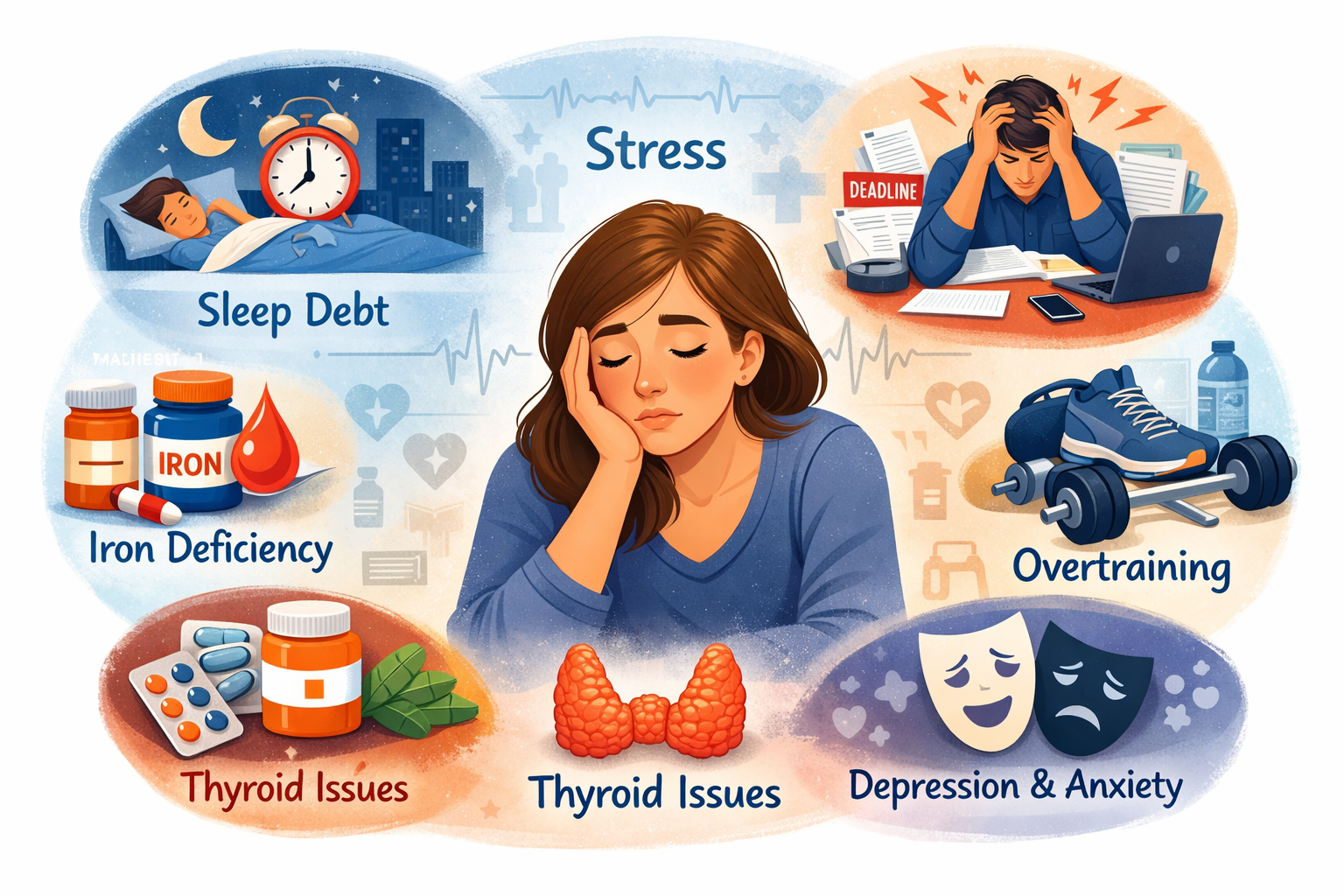


Fatigue is one of the most common reasons people bring up health concerns, but it is not a diagnosis by itself. It is a signal. Sometimes the explanation is obvious: too little sleep, too much stress, a hard training block, or a medication that makes you groggy. Sometimes it points to something worth checking, such as iron deficiency, thyroid dysfunction, depression, or anxiety. And sometimes several smaller problems stack up and create one big symptom.
That is why the first useful question is not “What disease do I have?” It is “Which pattern does this fatigue fit?”
In everyday practice, the most common explanations are usually not exotic. Sleep problems, psychological stress, depression, anxiety, medication side effects, and common medical issues tend to account for far more fatigue than rare illnesses do.
1. Sleep debt: the boring answer that is often the real one
Sleep debt is not dramatic, which is exactly why people miss it.
If you regularly sleep too little, go to bed late, split your sleep, scroll in bed, work into the evening, or rely on caffeine to get through the day, your body may not care that you are “technically functional.” The result can look like brain fog, low motivation, poor workout recovery, irritability, and the feeling that you are always running behind yourself.
A simple clue: do you feel noticeably better after several nights of longer sleep, on holidays, or after a quiet weekend with less alarm-clock pressure? If yes, sleep debt moves much higher on the list.
Another clue is the mismatch between how much you expect from yourself and how much sleep you actually get. Many people say they are “sleeping okay” when they are really averaging six hours and calling that normal. For adults, that is often not enough. Sleepiness is also not a trivial symptom. Modern sleep medicine treats it as clinically important because it is linked to lower quality of life, impaired performance, accidents, and broader health consequences.
This does not mean every tired person has a sleep disorder. It means chronic under-sleeping deserves more respect than it usually gets.
2. Stress: when the problem is not lack of sleep but lack of recovery
Stress-related fatigue does not always feel sleepy. Often it feels wired, tense, scattered, and depleted.
You may still be able to work. You may even look productive from the outside. But your system never really powers down. You wake up tired, push through the day, get a second wind late at night, and repeat the cycle. Workload, low control, poor boundaries, constant context-switching, and ongoing uncertainty all matter here. Large reviews of the workplace literature consistently link high job demands, high workload, low control, low support, low reward, and job insecurity with emotional exhaustion. Long-term cohort data also show that psychosocial work stress predicts later fatigue.
One important point for the article angle: burnout is not a formal medical diagnosis in ICD-11. The WHO classifies it as an occupational phenomenon related to chronic workplace stress that has not been successfully managed. That does not make it unreal. It means it should be described carefully. If your fatigue tracks closely with work stress, Sunday dread, irritability, and a sense that rest no longer restores you, stress deserves to be taken seriously.
3. Iron deficiency: common, under-recognized, and not always obvious on first glance
Iron deficiency is one of the easiest causes of fatigue to underestimate, especially when a person is not yet frankly anemic.
That matters because fatigue can show up before the classic “your hemoglobin is clearly low” picture appears. Heavy menstrual bleeding, frequent blood donation, endurance training, low iron intake, gastrointestinal blood loss, recent pregnancy, or absorption problems can all push this higher on the list. Restless legs, exercise intolerance, shortness of breath on exertion, paleness, brittle nails, or cravings for ice can add to the suspicion, but none of these is required.
This is also one of the better-studied areas in fatigue research. Randomized trials in non-anemic women with low ferritin found that iron supplementation improved fatigue more than placebo. Systematic reviews and meta-analyses have reached a similar general conclusion: in iron-deficient adults without anemia, iron treatment can reduce subjective fatigue, even though the effect on objective physical performance is less consistent.
The tricky part is interpretation. Ferritin thresholds differ across guidelines and clinical contexts, and inflammation can make ferritin look higher than the body’s true iron availability would suggest. So “your iron is normal” is not always the end of the story unless the numbers were interpreted in context.
4. Thyroid problems: worth checking, but not the answer to every low-energy week
The thyroid deserves its place in the fatigue conversation. Hypothyroidism can absolutely make people feel worn down, slowed down, cold, constipated, mentally dull, and physically heavy.
But this is where over-attribution happens. The classic symptoms are common and nonspecific. Plenty of people with fatigue wonder if it is their thyroid, and many of them are disappointed to find out that thyroid tests are normal. That is not because the symptom is imagined. It is because fatigue overlaps with many more common problems than thyroid disease does.
The nuance is even more important for borderline or subclinical cases. Trials in older adults with mild subclinical hypothyroidism did not show meaningful improvement in tiredness or fatigability with levothyroxine. In other words, a slightly abnormal thyroid number is not always the explanation for how tired someone feels, and treatment does not automatically fix the symptom.
Thyroid disease should stay on the list. It just should not take over the list.
5. Depression and anxiety: two of the most common explanations, and often the most missed
A lot of people still imagine depression as obvious sadness and anxiety as obvious panic. Real life is usually messier.
Depression often shows up as low energy, slowed thinking, poor concentration, disrupted sleep, loss of interest, guilt, heaviness, and the sense that even small tasks take too much effort. Anxiety often shows up as constant mental overdrive, shallow sleep, muscle tension, irritability, poor concentration, and daytime exhaustion. In both cases, fatigue is not a side note. It is often one of the central complaints.
This is also where people get stuck in the wrong story. They keep looking for a hidden nutritional deficiency or a hormonal explanation while ignoring the fact that they have stopped enjoying things, feel persistently on edge, cannot switch off, or wake up already drained by their own thoughts.
That does not mean fatigue is “just psychological.” It means the brain, sleep, stress response, and body are not separate systems. If tiredness comes with low mood, loss of interest, dread, rumination, panic symptoms, or a feeling that daily life has become harder to carry, depression and anxiety belong near the top of the differential, not at the bottom.
6. Medications: sometimes the cause is already in your medicine cabinet
Medication-related fatigue is common and often overlooked because the person started the drug for a legitimate reason and now assumes the tiredness must be something else.
Many drugs can contribute to fatigue through sedation, anticholinergic effects, blood pressure lowering, or general slowing of the central nervous system. Common culprits include sedating antihistamines, sleep aids, benzodiazepines and other sedatives, some antidepressants, opioids, muscle relaxants, antipsychotics, anticonvulsants, and some blood pressure medications.
Two practical clues help here. First, did the fatigue start soon after starting, increasing, or combining medications? Second, is there a predictable time of day when it gets worse after a dose? If yes, medication review should move up the list.
This is one area where self-diagnosis is risky. The right move is usually not to stop a medication on your own, but to review the full list with a clinician and look for dose effects, interactions, duplication, or easier substitutes.
7. Overtraining: sometimes it is really under-recovery, and sometimes it is under-fueling
Athletes and highly active people are especially good at normalizing fatigue.
A short period of tiredness during hard training can be expected. True overtraining syndrome is a more serious, longer-lasting problem with performance decline, fatigue, mood change, and poor recovery after a persistent mismatch between load and recovery. It is also difficult to diagnose cleanly. There is no single gold-standard test, and sports medicine reviews describe it as a diagnosis of exclusion.
That matters because many people use “overtraining” to describe a wider cluster of problems: not enough calories, not enough carbohydrate, not enough sleep, too much life stress, too little rest, or some combination of all of them. The current sports medicine literature also emphasizes the overlap between overtraining-type symptoms and relative energy deficiency in sport.
A useful real-world question is not “Am I overtraining?” but “Am I recovering enough for the load I am carrying?” If your performance is dropping, soreness lingers, motivation is falling, sleep is getting worse, and your life stress is high, the answer may be yes even before you meet anyone’s strict definition.
How to narrow it down before you spiral
If you are trying to make sense of fatigue, start with patterns, not panic.
Ask yourself:
- Am I sleepy, or am I exhausted?
- Do I feel better after more sleep?
- Did this begin after a stressful period, a medication change, or a hard training block?
- Do I have clues pointing toward iron deficiency, such as heavy periods or low ferritin in the past?
- Do I also have low mood, loss of interest, worry, or panic symptoms?
- Am I expecting my body to perform well while under-sleeping, under-eating, or never fully resting?
If fatigue has been persistent, the most efficient medical workup is usually not a giant fishing expedition. It is a focused history, a medication review, a sleep and mental health screen, and a small set of sensible tests guided by the pattern. That is how primary care guidelines approach it.
When not to self-triage
Fatigue should not be brushed off if it is persistent, worsening, or accompanied by red flags.
The list includes chest pain, shortness of breath, fainting, black stools, significant unintentional weight loss, fever, major functional decline, very heavy bleeding, or symptoms of depression with thoughts of self-harm. In those situations, the goal is not to “optimize recovery.” It is to get properly assessed.
The bottom line
Most fatigue is not mysterious. It is layered.
The common reasons are common for a reason: sleep debt, chronic stress, iron deficiency, thyroid disease, depression, anxiety, medication effects, and training-recovery mismatch explain a large share of real-world tiredness. The fastest path forward is usually not chasing the rarest diagnosis first. It is narrowing the pattern, checking the obvious, and treating fatigue like a clue rather than an identity.
Sources
- Kornder N, et al. Tiredness/Fatigue—S3 Guideline Update. 2023. DEGAM.
- Latimer KM, Gunther A, Kopec M. Fatigue in Adults: Evaluation and Management. American Family Physician. 2023.
- Stadje R, et al. The Differential Diagnosis of Tiredness: A Systematic Review. BMC Family Practice. 2016.
- Maisel P, et al. Fatigue as the Chief Complaint: Epidemiology, Causes, Diagnosis, and Treatment. Deutsches Ärzteblatt International. 2021.
- Smith MT, et al. Use of Actigraphy for the Evaluation of Sleep Disorders and Circadian Rhythm Sleep-Wake Disorders: An American Academy of Sleep Medicine Clinical Practice Guideline. Journal of Clinical Sleep Medicine. 2018.
- Aronsson G, et al. A Systematic Review Including Meta-analysis of Work Environment and Burnout Symptoms. BMC Public Health. 2017.
- Snook J, et al. British Society of Gastroenterology Guidelines for the Management of Iron Deficiency Anaemia in Adults. Gut. 2021.
- World Health Organization. WHO Guideline on Use of Ferritin Concentrations to Assess Iron Status in Individuals and Populations. 2020.
- Verdon F, et al. Iron Supplementation for Unexplained Fatigue in Non-anaemic Women: Double Blind Randomised Placebo Controlled Trial. BMJ. 2003.
- Vaucher P, et al. Effect of Iron Supplementation on Fatigue in Nonanemic Menstruating Women with Low Ferritin: A Randomized Controlled Trial. CMAJ. 2012.
- Houston BL, et al. Efficacy of Iron Supplementation on Fatigue and Physical Capacity in Non-anaemic Iron-deficient Adults: A Systematic Review of Randomised Controlled Trials. BMJ Open. 2018.
- National Institute for Health and Care Excellence. Thyroid Disease: Assessment and Management (NG145). Last reviewed 2025.
- Stuber MJ, et al. Effect of Thyroid Hormone Therapy on Fatigability in Older Adults with Subclinical Hypothyroidism: A Nested Study Within a Randomized Placebo-Controlled Trial. 2020.
- National Institute for Health and Care Excellence. Depression in Adults: Treatment and Management (NG222). Last reviewed 2026.
- National Institute for Health and Care Excellence. Generalised Anxiety Disorder and Panic Disorder in Adults (CG113).
- National Institute of Mental Health. Depression.
- National Institute of Mental Health. Generalized Anxiety Disorder: What You Need to Know.
- Rosenthal TC, Majeroni BA, Pretorius R, Malik K. Fatigue: An Overview. American Family Physician. 2008.
- Zlott DA, Byrne M. Mechanisms by Which Pharmacologic Agents May Contribute to Fatigue. PM&R. 2010.
- World Health Organization. Burn-out an “Occupational Phenomenon”: International Classification of Diseases. 2019; and Guidelines on Mental Health at Work. 2022.
- Meeusen R, et al. Prevention, Diagnosis, and Treatment of the Overtraining Syndrome: Joint Consensus Statement of the ECSS and the ACSM. 2013.
- Carrard J, et al. Diagnosing Overtraining Syndrome: A Scoping Review. 2022.
- Mountjoy M, et al. 2023 International Olympic Committee Consensus Statement on Relative Energy Deficiency in Sport (REDs). British Journal of Sports Medicine. 2023.