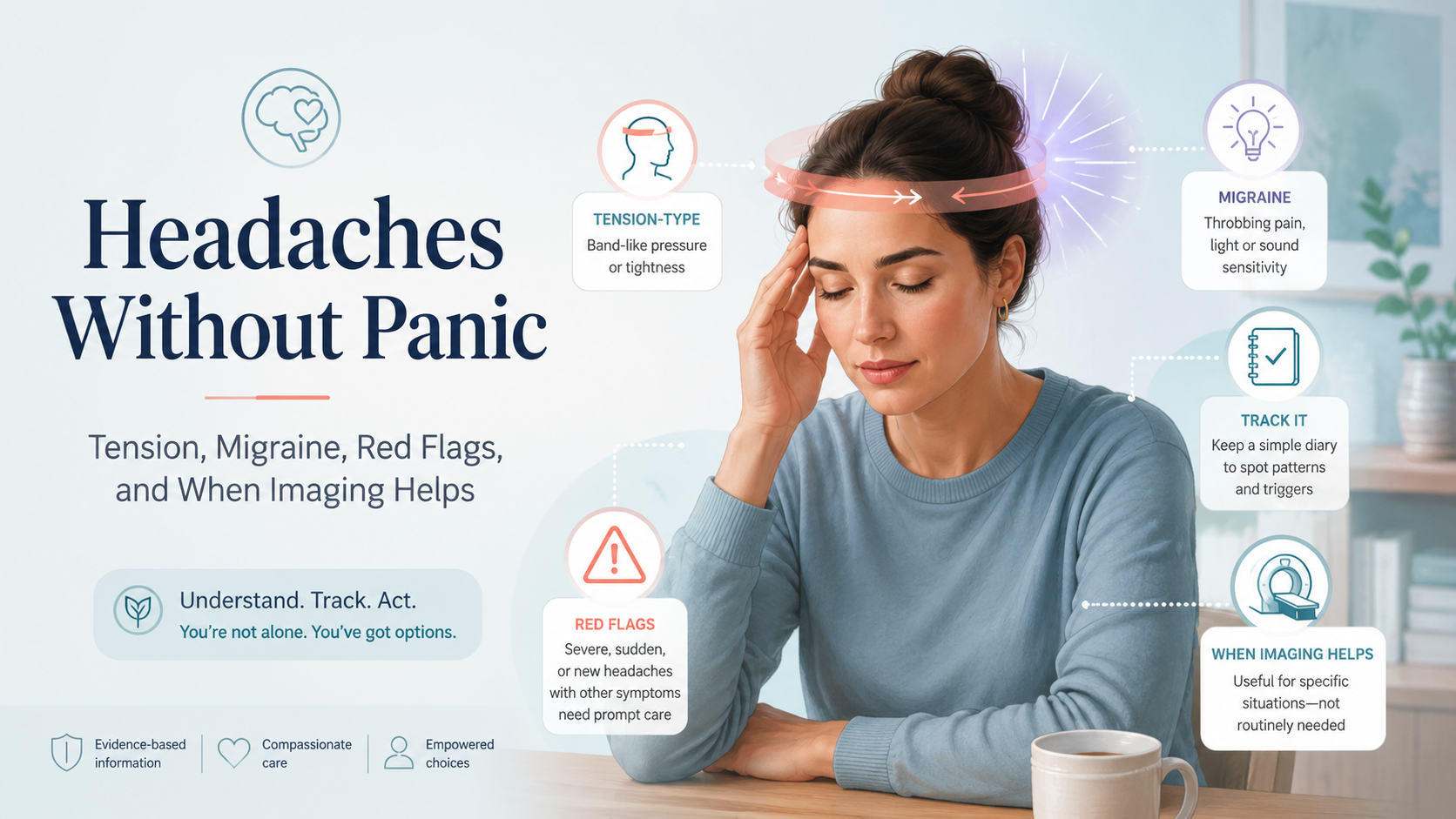


Headaches are common. Very common.
Most people will experience headaches at some point, and many people have them more than once. A headache can be painful, distracting, and exhausting, but it does not automatically mean that something dangerous is happening in the brain.
The useful question is: does this headache fit a familiar pattern, or is something about it new, sudden, progressive, or unusual?
That distinction helps avoid two common problems. One is ignoring symptoms that need urgent medical attention. The other is assuming that every headache needs a brain scan. Most headaches need neither panic nor guesswork. They need pattern recognition, a few safety checks, and sometimes a clear plan with a clinician.
This article explains the common patterns, the warning signs, what to track, and when imaging can actually help.
Primary and secondary headaches
Doctors often divide headaches into primary and secondary headaches.
Primary headaches are headache disorders in their own right. They are not caused by another disease. Migraine, tension-type headache, and cluster headache are examples. They can be highly disabling, even when scans are normal.
Secondary headaches are caused by another condition. This could be infection, bleeding, head injury, inflammation, medication overuse, raised pressure around the brain, eye disease, or another medical problem.
Most recurring headaches in otherwise well people are primary headaches. That does not make them “imaginary” or minor. It means the history matters: how the headache feels, how long it lasts, what comes with it, how often it happens, what medicines are used, and whether the pattern is stable or changing.
Tension-type headache: pressure, tightness, and the “band” feeling
Tension-type headache is one of the most common headache patterns. People often describe it as pressure, tightness, or a band-like feeling around the head. It often affects both sides and is usually mild to moderate rather than severe.
The pain is usually pressing or tightening rather than throbbing. It often does not worsen much with ordinary activity, and nausea or vomiting are not typical. Some people also notice tenderness in the scalp, neck, jaw, or shoulder muscles.
This pattern can be linked with poor sleep, long screen time, stress, skipped meals, dehydration, jaw clenching, or posture strain. Still, the word “tension” can be misleading. It does not mean the pain is “just stress” or that the person is overreacting.
For many people, tension-type headache improves with rest, hydration, regular meals, sleep correction, movement breaks, reduced screen strain, and simple pain relief when appropriate. If it becomes frequent, persistent, or different from usual, it deserves medical review.
Migraine: more than a bad headache
Migraine is often misunderstood as simply a severe headache. It is broader than that.
A migraine attack can include head pain, nausea, light sensitivity, sound sensitivity, smell sensitivity, dizziness, fatigue, brain fog, neck discomfort, and a strong need to stop activity. Some people also have aura, which means temporary neurological symptoms such as visual changes, tingling, numbness, or speech disturbance before or during the attack.
A typical migraine attack in adults may last from 4 to 72 hours if untreated or unsuccessfully treated. The pain is often moderate or severe, may be throbbing, may affect one side of the head, and often worsens with routine movement. Nausea, vomiting, and sensitivity to light or sound are common.
Migraine can be triggered by sleep disruption, missed meals, alcohol, hormonal changes, dehydration, weather changes, intense exercise, or the recovery period after stress. But triggers are not the same as causes. Migraine is a neurological disorder, and attacks can happen even when a person has done everything “right.”
This matters because people with migraine are often told to drink more water, relax, or avoid stress. Those steps may help some people, but frequent or disabling migraine often needs a proper diagnosis and treatment plan.
Red flags: when a headache needs urgent attention
Most headaches are not emergencies. Some are.
Urgent medical care is needed when a headache is sudden, severe, and reaches maximum intensity within seconds or minutes. This is often called a thunderclap headache. It is especially important to act quickly if the person describes it as the worst headache of their life.
Other warning signs include new weakness, numbness, facial droop, confusion, trouble speaking, trouble walking, double vision, loss of vision, fainting, seizure, fever, neck stiffness, rash, severe light sensitivity with feeling very unwell, headache after a head injury, a new headache during pregnancy or after delivery, a new headache after age 50, or headache in someone with cancer, HIV, significant immune suppression, or recent serious infection.
A headache also needs prompt assessment if it is progressively worsening over days or weeks, clearly different from a person’s usual pattern, triggered by coughing, exertion, sex, or a change in body position, or associated with a painful red eye and sudden visual symptoms.
These signs do not always mean that something dangerous is present. They mean the headache should not be managed as a routine headache at home.
When CT or MRI helps
CT and MRI are powerful tools, but they are not universal headache tests.
Imaging helps most when the story or examination suggests a possible secondary cause. This may include thunderclap onset, new neurological signs, head trauma, cancer history, immune suppression, pregnancy or postpartum state, a new headache after age 50, swelling of the optic disc, or a headache that changes with position or exertion.
For a typical migraine or tension-type headache, with a normal neurological examination and no red flags, imaging is usually not needed.
That can feel counterintuitive. Many people want a scan for reassurance. But scans can also create problems: incidental findings, unnecessary anxiety, extra tests, radiation exposure with CT, cost, and delay in getting the right treatment.
A normal scan also does not prove that the pain is “nothing.” Migraine and tension-type headache usually do not show up on standard imaging. They are diagnosed mainly from the clinical pattern.
The practical rule is simple: imaging is most useful when the headache is unusual, high-risk, or accompanied by concerning signs. It is less useful when the pattern is typical, stable, and the neurological examination is normal.
The medication-overuse trap
Pain relief can be appropriate. The problem begins when acute headache medication is used too often.
Medication-overuse headache can develop in people with migraine or tension-type headache who regularly use painkillers or migraine medicines over time. A practical threshold is around 10 or more days per month for triptans, opioids, ergot medicines, or combination painkillers, and 15 or more days per month for simple painkillers such as paracetamol, aspirin, or NSAIDs.
This does not mean people should suffer without treatment. It means frequent headaches need a plan, not just repeated rescue medication. If you are counting tablets, rationing painkillers, or needing medication many days each month, it is time to discuss diagnosis, prevention, and safer long-term management with a clinician.
What to track before seeing a doctor
A headache diary is often more useful than trying to remember everything during a short appointment.
For several weeks, and ideally for around eight weeks, record when the headache happened, how long it lasted, how severe it was, where the pain was located, what the pain felt like, what symptoms came with it, what medicine you took, whether it helped, and how many days per month you used headache medication.
It is also useful to note sleep, stress, alcohol, missed meals, dehydration, exercise, screen time, menstrual cycle if relevant, and anything new or unusual.
The goal is not to obsess over every detail. The goal is to give your clinician enough information to separate common headache patterns from concerning changes.
When to book a routine appointment
A headache does not have to be an emergency to deserve care.
Book a medical appointment if headaches are becoming more frequent, if you need pain medication often, if headaches interfere with work, sleep, exercise, or daily life, if you have migraine symptoms but no diagnosis, or if the headache pattern has changed.
A good consultation should cover the headache pattern, neurological symptoms, medication use, sleep, stress, hormonal pattern where relevant, blood pressure, neck and jaw symptoms, eye symptoms, and general health.
What people often get wrong
Many people call recurring headaches “sinus headaches,” but repeated sinus-like headaches are often migraine, especially when there is nausea, light sensitivity, worsening with activity, or no clear infection.
A normal scan does not mean the pain is fake. Migraine and tension-type headache are real conditions and usually do not appear on standard imaging.
A severe headache is not automatically dangerous. Migraine can be severe. Cluster headache can be excruciating. Severity matters, but the pattern and associated symptoms matter more.
A mild headache is not always harmless. A new headache with neurological symptoms, fever, cancer history, immune suppression, pregnancy, or sudden unusual onset still deserves attention.
A calm way to think about headaches
When a headache happens, ask three questions.
Is it sudden, severe, or the worst headache you have had?
Are there neurological symptoms, fever, fainting, seizure, trauma, pregnancy or postpartum state, cancer, immune suppression, or a clearly new pattern?
If the headache is familiar, how often is it happening, how much medication are you using, and is it affecting your life?
If the answer to the first two questions raises concern, seek urgent medical advice. If the answer to the third shows a growing pattern, book a routine appointment.
Most headaches do not need panic. Some need prompt care. Many need better tracking, better diagnosis, and a plan that does not rely on guessing.
Sources
- World Health Organization. Migraine and other headache disorders
- Stovner LJ et al. The global prevalence of headache: an update. The Journal of Headache and Pain, 2022
- International Headache Society. The International Classification of Headache Disorders, 3rd edition
- NICE. Headaches in over 12s: diagnosis and management. Clinical guideline CG150
- American College of Radiology. ACR Appropriateness Criteria: Headache
- Evans RW et al. Neuroimaging for Migraine: American Headache Society systematic review and evidence-based guideline. Headache, 2020
- Do TP et al. Red and orange flags for secondary headaches in clinical practice: SNNOOP10 list. Neurology, 2019
- Choosing Wisely Canada. Headache recommendations
- NICE Clinical Knowledge Summaries. Medication-overuse headache
- American Heart Association / American Stroke Association. 2023 Guideline for the Management of Patients With Aneurysmal Subarachnoid Hemorrhage