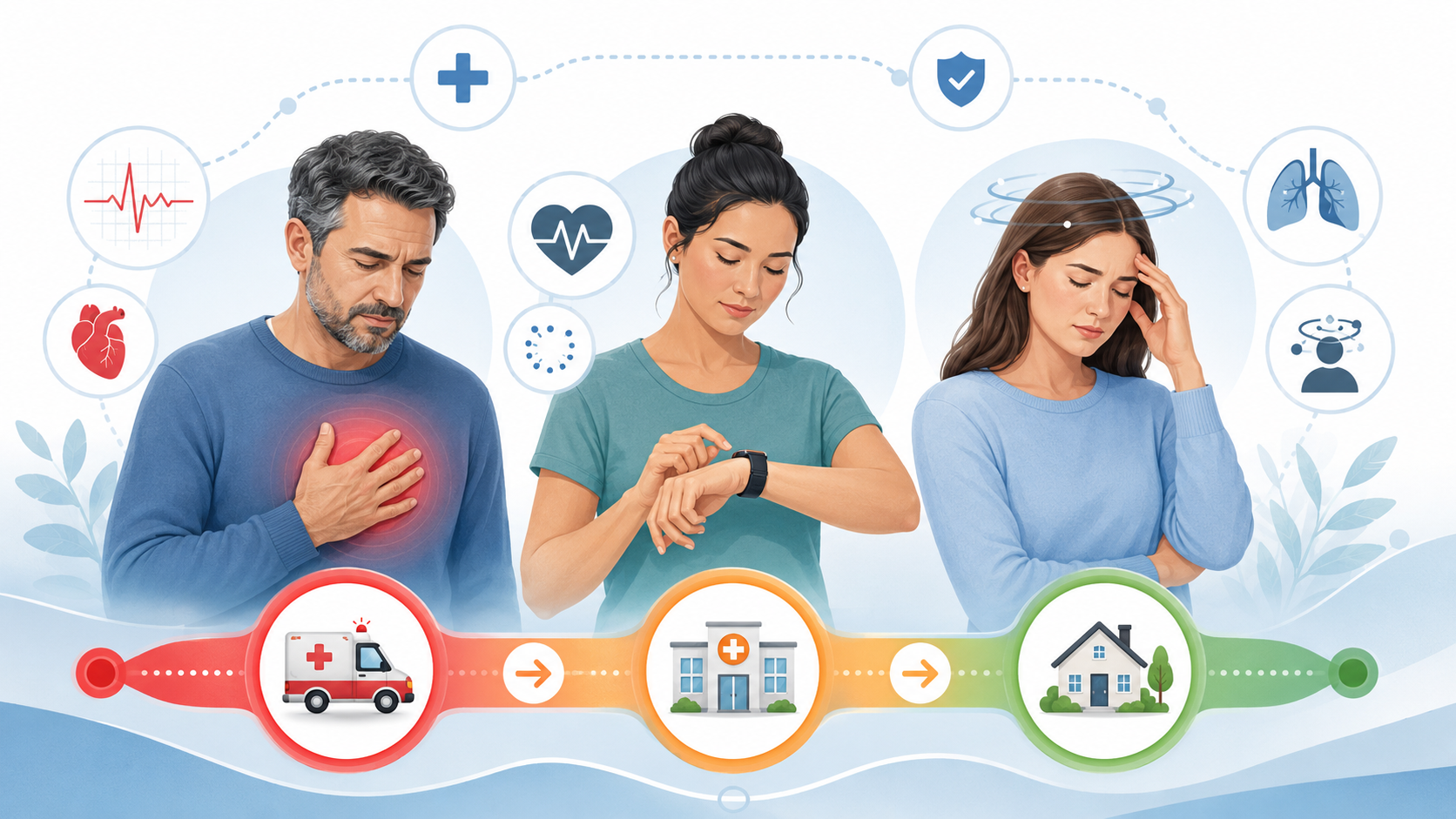


Chest pain, a racing heartbeat, and dizziness are common symptoms. They can happen after stress, poor sleep, dehydration, caffeine, exercise, a viral illness, or simply from standing up too quickly.
Most episodes are not a medical emergency.
The challenge is that a small number of episodes can be the first sign of something serious, including a heart attack, an abnormal heart rhythm, a blood clot in the lungs, a stroke, or another condition that needs fast treatment.
This article is a practical guide to help you decide when to seek emergency care, when to arrange same-day medical advice, and when it may be reasonable to book a routine appointment.
It is not a diagnostic tool. The safest question is not “What is the most likely cause?” The safer question is “Does this pattern need urgent assessment?”
The rule of combinations
One symptom on its own can be hard to interpret.
A brief flutter in the chest after too much coffee may be harmless. Mild lightheadedness after standing up quickly may pass within seconds. Chest soreness after lifting weights may come from the chest wall.
Combinations matter more.
Chest discomfort plus shortness of breath is different from chest discomfort alone. Palpitations plus fainting are different from palpitations alone. Dizziness plus trouble speaking, weakness, or loss of balance is different from mild lightheadedness after standing.
When symptoms cluster together, the threshold for urgent care should be lower.
Seek emergency care now for chest pain with red flags
Chest pain is not always felt as “pain.” It may feel like pressure, tightness, heaviness, burning, squeezing, or an unusual discomfort. It may be in the centre of the chest, but it can also spread to the arm, shoulder, neck, jaw, back, or upper abdomen.
Seek emergency care now, or call your local emergency number, if chest pain or chest discomfort:
- feels new, severe, heavy, tight, or unusual for you
- lasts more than a few minutes
- goes away and comes back
- spreads to the arm, jaw, neck, back, shoulder, or upper abdomen
- happens with shortness of breath
- happens with cold sweat, nausea, vomiting, or marked weakness
- happens with fainting or nearly fainting
- happens with a rapid or irregular heartbeat
- starts during exercise or does not settle with rest
Do not try to decide at home whether this is anxiety, reflux, indigestion, or a pulled muscle if chest discomfort comes with breathlessness, sweating, nausea, fainting, or pain spreading to the arm, jaw, back, or neck.
Those symptoms do not prove a heart attack. They do mean you should be assessed quickly.
When chest pain may be less urgent
Chest discomfort may be less urgent when it is mild, brief, fully resolved, and clearly linked to a harmless trigger.
For example, it may be reasonable to book a routine appointment rather than seek emergency care if the discomfort is:
- clearly related to movement, posture, or pressing on a specific sore area
- brief and does not return
- not associated with breathlessness, sweating, nausea, weakness, fainting, or palpitations
- not triggered by exercise
- not spreading to the arm, jaw, neck, back, or upper abdomen
Even then, “less urgent” does not mean “ignore it.” If chest discomfort is new for you, keeps coming back, happens during exertion, or worries you, get medical advice.
A useful rule: if you are trying to convince yourself that chest pain is “probably nothing,” it is safer to ask for medical advice than to negotiate with the symptom.
Palpitations: when a racing or irregular heartbeat needs care
Palpitations are sensations of a racing, pounding, fluttering, skipping, or irregular heartbeat. They are common. They can be triggered by caffeine, alcohol, stress, poor sleep, dehydration, fever, some medications, thyroid problems, low iron, and many other causes.
Many palpitations are benign. Some are caused by abnormal heart rhythms that need diagnosis and treatment.
Seek emergency care now if palpitations happen with:
- chest pain or chest pressure
- fainting or nearly fainting
- severe shortness of breath
- confusion or marked weakness
- new neurological symptoms, such as weakness on one side, trouble speaking, or vision changes
- a very fast or irregular heartbeat with feeling seriously unwell
Arrange same-day medical advice if you notice:
- a new irregular pulse
- repeated episodes of racing heartbeat
- palpitations with dizziness
- palpitations during exercise
- episodes that are becoming longer, more frequent, or harder to recover from
- palpitations in the setting of known heart disease
A routine appointment may be reasonable if you had a single brief episode of skipped beats, it passed quickly, and there was no chest pain, fainting, shortness of breath, dizziness, or neurological symptom.
Still, recurring palpitations deserve assessment. A normal ECG between episodes does not always rule out an intermittent rhythm problem. Some people need ambulatory monitoring, such as a 24-hour monitor, longer patch monitor, or event recorder, to capture the rhythm during symptoms.
Wearables can be useful for noticing patterns, especially irregular pulse alerts, but they do not replace medical diagnosis.
Dizziness: common, but context matters
“Dizziness” can mean different things. Some people mean spinning vertigo. Others mean lightheadedness, imbalance, faintness, or feeling detached.
The word itself is less important than the pattern.
Ask:
When did it start?
Was it sudden or gradual?
Is it constant or in short episodes?
Is it triggered by head movement, standing, exercise, or stress?
Is it linked with chest pain, palpitations, shortness of breath, fainting, headache, weakness, speech problems, or vision changes?
Seek emergency care now if dizziness is sudden or severe and happens with:
- weakness or numbness, especially on one side of the body
- trouble speaking or understanding speech
- facial drooping
- new vision loss or double vision
- trouble walking, loss of coordination, or inability to stand normally
- sudden severe headache
- fainting
- chest pain or severe shortness of breath
- a new rapid or irregular heartbeat
- head injury
- confusion or reduced alertness
Sudden dizziness with trouble walking, vision changes, weakness, numbness, or speech problems should be treated as possible stroke until proven otherwise.
It may be reasonable to monitor or arrange a routine appointment if dizziness is mild, brief, fully resolved, and clearly linked to a benign trigger, such as standing up quickly, missing a meal, dehydration, or a hot environment.
But if dizziness is new, persistent, recurrent, or hard to explain, medical assessment is sensible.
Fainting and near-fainting
Fainting, also called syncope, means a temporary loss of consciousness with recovery. Near-fainting means you felt close to passing out but did not fully lose consciousness.
Some faints are vasovagal. They may happen after pain, fear, heat, dehydration, standing for a long time, or seeing blood. These episodes often come with warning signs such as nausea, warmth, sweating, tunnel vision, or feeling lightheaded.
Other faints can be related to the heart, blood pressure, rhythm problems, blood loss, neurological conditions, or medication effects.
Seek urgent medical assessment, and often emergency care, if fainting or near-fainting happens:
- during exercise
- while lying down
- without warning
- immediately after palpitations
- with chest pain, breathlessness, severe headache, back pain, or abdominal pain
- with injury
- with incomplete recovery or confusion afterward
- in someone with known heart disease
- in someone with a family history of sudden cardiac death
- in an older adult, especially if there was no clear trigger
A faint with a clear vasovagal trigger and quick full recovery may be less alarming, but a first unexplained faint should still be discussed with a clinician.
Do not self-diagnose anxiety too quickly
Anxiety and panic can cause chest tightness, palpitations, shortness of breath, trembling, dizziness, and a sense of danger. These symptoms can feel very physical because they are physical.
Anxiety is real. Panic attacks are real. They can be frightening and deserve proper care.
The risk is using anxiety as an explanation before dangerous causes have been considered.
This is especially important if symptoms are new, different from previous panic episodes, triggered by exercise, associated with fainting, or accompanied by neurological signs, chest pressure, or severe shortness of breath.
A better approach is: rule out urgent causes first, then treat anxiety seriously if that is the likely diagnosis.
What clinicians may check
When you seek care for chest pain, palpitations, dizziness, or fainting, clinicians do not rely only on the symptom description. Depending on the situation, assessment may include:
- blood pressure and pulse
- oxygen level
- temperature
- heart and lung exam
- neurological exam
- 12-lead ECG
- blood tests, including cardiac troponin when heart attack is a concern
- rhythm monitoring
- pregnancy test where relevant
- tests for anaemia, thyroid disease, infection, or electrolyte problems
- imaging when blood clot, stroke, aortic disease, or lung disease is suspected
This is why “it can wait” is different after a proper assessment than before one. A clinician can sometimes safely reassure a person after checking risk factors, ECG, vital signs, and blood tests. That is very different from guessing at home.
A simple triage guide
Go to emergency care now
Go now if you have chest pain, palpitations, dizziness, or fainting with any of the following:
- chest pressure, tightness, heaviness, or pain that lasts or returns
- shortness of breath
- cold sweat, nausea, vomiting, or marked weakness
- pain spreading to the arm, jaw, neck, back, shoulder, or upper abdomen
- fainting or nearly fainting
- rapid or irregular heartbeat with feeling unwell
- sudden trouble speaking, seeing, walking, balancing, or moving one side of the body
- sudden severe headache
- coughing blood
- sudden severe chest, back, or abdominal pain
- symptoms during exercise
- known heart disease, previous blood clot, known aortic aneurysm, or recent surgery or immobilisation
Seek same-day medical advice
Seek same-day care if you have:
- recent chest pain that has now settled but was new or concerning
- new irregular pulse
- repeated palpitations
- palpitations with dizziness
- unexplained near-fainting
- persistent dizziness or vertigo
- symptoms that are becoming more frequent, longer, or more intense
- symptoms that occur with exercise, even if they later settle
It may be reasonable to book routine care
Routine care may be reasonable when symptoms are mild, brief, fully resolved, clearly linked to a benign trigger, and not associated with red flags.
Examples include:
- a single brief skipped-beat sensation after caffeine, with no other symptoms
- mild lightheadedness after standing up quickly, resolving within seconds
- chest wall soreness after exercise that is worse with movement or pressing on the area, with no breathlessness, sweating, nausea, fainting, or radiation
If symptoms recur, change, or worry you, book an appointment.
The bottom line
Chest pain, palpitations, and dizziness are common. Most episodes are not dangerous. The safest approach is to look for patterns that need fast assessment.
Do not panic about every flutter, ache, or dizzy spell. But do not ignore symptoms that come in risky combinations.
Chest pain with breathlessness, sweating, nausea, fainting, or pain spreading to the arm, jaw, neck, or back needs emergency care.
Palpitations with fainting, chest discomfort, severe shortness of breath, or feeling seriously unwell need urgent assessment.
Dizziness with weakness, speech problems, vision changes, loss of coordination, severe headache, chest pain, or fainting should be treated as urgent.
When in doubt, choose safety. Getting checked quickly is often the most practical way to reduce both medical risk and anxiety.
Sources
- 2021 AHA/ACC Guideline for the Evaluation and Diagnosis of Chest Pain.
- NICE CG95: Recent-onset chest pain of suspected cardiac origin.
- 2022 ACC Expert Consensus Decision Pathway on acute chest pain in the emergency department.
- American Heart Association: Heart Attack Warning Signs.
- NICE NG196: Atrial fibrillation diagnosis and management.
- 2023 ACC/AHA/ACCP/HRS Guideline for atrial fibrillation.
- 2024 ESC Guidelines for atrial fibrillation.
- 2019 ESC Guidelines for supraventricular tachycardia.
- GRACE-3: Acute dizziness and vertigo in the emergency department.
- CDC Stroke Signs and Symptoms.
- NICE CG109: Transient loss of consciousness.
- 2018 ESC Guidelines for syncope.
- 2019 ESC Guidelines for acute pulmonary embolism.
- 2022 ACC/AHA Guideline for the Diagnosis and Management of Aortic Disease.